THE PEOPLE / THE DECISION / THE UNANSWERED WHY
Volunteer service deserves a future.
Norwich’s volunteer firefighters have given their time, skills and local knowledge to protect their neighbors. That contribution deserves a future in a modern, accountable fire service.
The City removed Yantic and Taftville from fire-service operations. Paid coverage continued, but the companies’ ability to serve changed fundamentally. Allowing individual volunteers to participate is different from restoring their companies.
Read the decision and its limits
The City’s September 10, 2026 brief, page 2, defends the removal of the companies from operations. This is the City’s position in litigation, not a judicial holding that the action was justified or unlawful.
City brief · September 10 · p. 2The June 3 order concerns station vacation and six apparatus, a separate consequence. June 3 order · pp. 1–2
Supplied photographs: Yantic, Taftville, Occum and Laurel Hill. Company history and community support; sign dates are historical. The removal discussed here concerns Yantic and Taftville.
OUR POSITION / TEST THE JUSTIFICATION
After asking why,
the missing link still matters.
After reviewing correspondence, assessments, incident records and court filings, we remain unconvinced that the evidence adequately explains why removing these companies was necessary. Residents deserve a clear connection between the problems identified, the action taken and the alternatives considered.
OUR REVIEW / THE JUSTIFICATION QUESTION
Over 4,000 files and attachments received from the city so far.
We have not found one that substantiates closing these fire departments.
Review is ongoing. Written assessments and incident reports exist. The question is whether the evidence justifies excluding Yantic and Taftville from operations, rather than addressing specific problems while preserving qualified volunteer service.
01What happened to the 100-call review?
We asked for the records behind the “100 incidents” account: incident identifiers, staffing, dispatch records, contemporaneous notes, analyses and briefings. When the supplied reports raised timing questions, we requested unit-level timestamps. We later asked for report drafts and transmittal emails, or identification of another record set.
The unresolved link: Four February written assessments exist. How do those assessments, the incident records and verbal reports document the specific review and support the conclusions drawn?
Read the dated requests
What we asked for, and what came back
February 25, 2026 · Incident details
The request specified incident numbers, dates and times, locations, incident types, dispatched and on-scene units, personnel totals and volunteer participation. The requester offered to clarify the time frame. The Clerk acknowledged forwarding it that day.
The Chief supplied reporting-system records on March 10, explaining that recorded official actions do not capture every incident he attended.
Source: 16-page chain, pp. 13-16; redacted packet pp. 14-17.
Read these pages in the redacted packetMarch 10–11 · The compilation behind the account
The follow-up sought a list, dataset or compilation; dispatch/CAD or the currently used equivalent; incident and command summaries; contemporaneous notes; internal analyses and briefings; and confirmation if no documented compilation existed.
On March 11 the Chief said he had supplied all records kept by the Fire Department, again distinguishing recorded actions from attendance. At 9:47 AM the requester initially acknowledged completion. Later questions followed examination of the records.
Source: 16-page chain, pp. 7-13; redacted packet pp. 8-14.
Read these pages in the redacted packetMarch 11, 1:21 PM · Unit-level timestamps
After examining the reports, the requester questioned identical dispatch/arrival times despite narratives describing sequential arrivals. He asked how the timestamps were generated and sought underlying unit-level dispatch and arrival timestamps if the displayed times were summaries.
No resolving reply appears in this 16-page chain. That does not prove no reply or records exist elsewhere, or establish the actual incident durations.
Source: 16-page chain, pp. 5-8; redacted packet pp. 6-9.
Read these pages in the redacted packetApril 7–8 · Identify the report or another record set
The renewed request sought drafts, a final report, written analysis and transmittal emails. If the budget-meeting statement referred to a different document or record set, the requester asked for it to be identified specifically.
On April 8 the Chief limited his assurance to requested documents in his possession. The requester clarified that the request also included the City Manager’s records, not just the Chief’s office.
Source: 16-page chain, pp. 1-5; redacted packet pp. 2-6. The final request is dated April 13, 2026, 6:36:58 PM (chain p. 1 / packet p. 2).
Read these pages in the redacted packetThese are paraphrased selections from a 16-page correspondence chain. The screened 19-page review packet contains that chain, a reading guide and two separate February 24 context pages. Only the requester’s name and email are redacted; officials’ business details, signatures, dates and contrary context remain. The private original is not published.
The four written assessments and their February 24 transmittal were located elsewhere. The Manager’s April 14 “verbal reports” reply is in a separate verified request-and-reply exhibit. Read its request and possession context alongside those assessments; neither chain proves that no review or safety concerns existed.
February 24 attachment-title context — packet pp. 18–19Four assessments and February 24 transmittal · existing source notesSeparate April 14 replies · screened public transcriptionThe public six-month / more-than-100 account is a caption-derived paraphrase, not an audio-verified quotation. The remaining question is the connection between the review, the evidence, each action and the alternatives considered.
Read criticism beside contrary evidence.
The reviewed incident narratives include operational criticism. They also record useful volunteer work and problems involving paid crews and city alerting. Those accounts deserve individual scrutiny, with their limits visible.
Why it matters: An incident-specific problem does not, by itself, explain a company-wide removal. A fair account must show how both supporting and contrary evidence were weighed.
Read the reviewed scope and examples
The October 2 review read 18 report files covering 17 incident identities across 141 pages. It did not independently reconstruct incidents or verify every table field. Two files are different versions of one incident. Repeated wording is not independent corroboration.
Selected incident notes · individual and combined page referencesReform can preserve volunteer service.
The February 2021 McGrath study supported continuation of both career and volunteer providers while recommending substantial coordination, training and oversight reforms.
Why it matters: The need for reform alone does not explain why company removal was necessary, or why less disruptive alternatives would not work.
Read the recommendation and its qualifications
Pages 15–17 address integration and governance, including standardization and a fire commissioner. These are historical recommendations, not a present safety certification or proof of a consensus on today’s dispute.
McGrath study · February 2021 · pp. 15–17Why is the union involved?
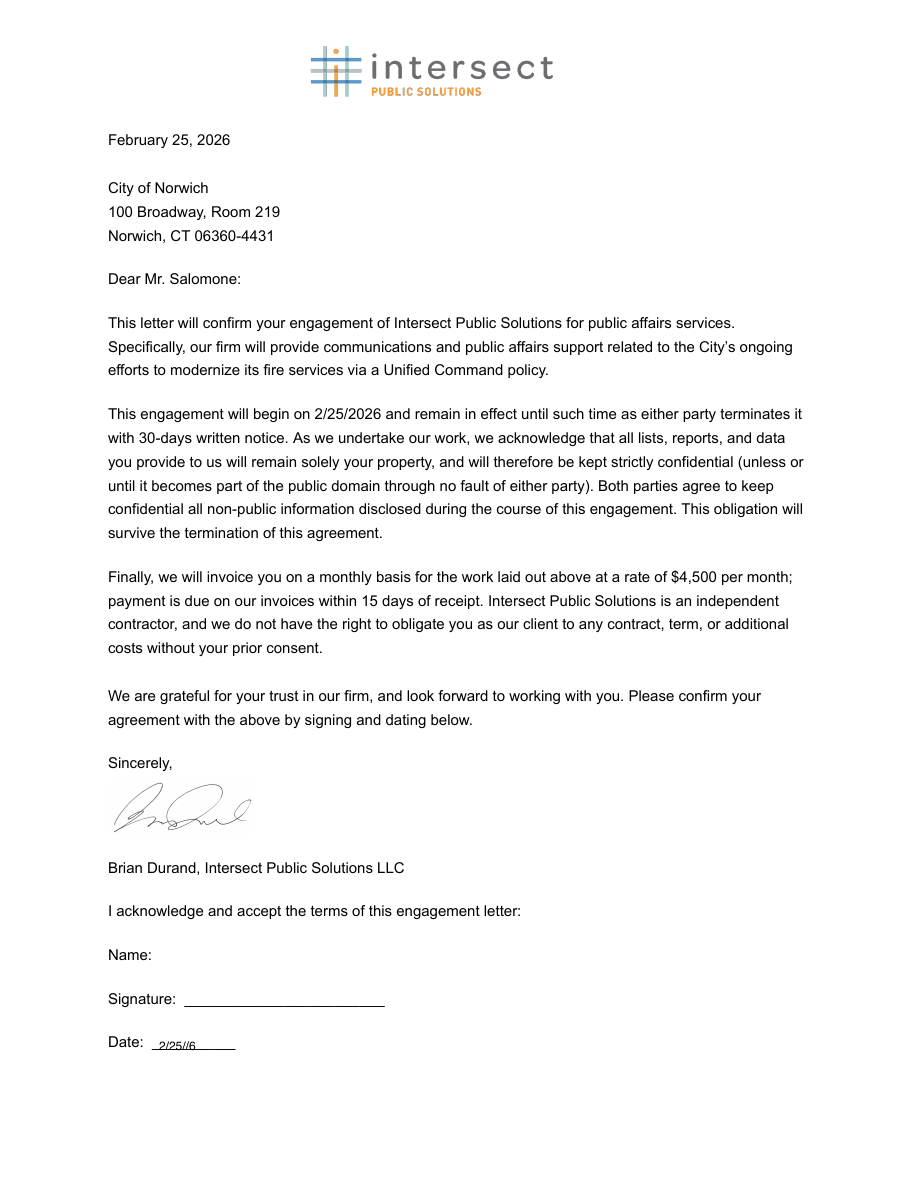
Why did City Hall bring its PR contractor into union advocacy?
Emails show City officials involving IPS in the union’s op-ed placement effort, followed by union review of a separate press release the City issued.
- Union op-ed
- City and IPS
- Separate release
- Union review
- City distribution
“The press release looks good from my end.”
Michael Podzaline, Local 892 president
March 11, 9:31 AM
Our question: What public purpose was served by involving the City’s PR contractor in promoting the union’s op-ed?
Read the emails →Check the source and the limits
The opinion piece and the separate press release are distinct outputs. The emails document coordination; they do not establish the amount charged for this work, an unlawful motive or why a company was removed.
Read the approval email (screened PDF, packet page 4; opens in a new tab)