A document proves what it contains—not automatically that every statement inside is true.
Each entry separates the claim, its current evidentiary status, the narrow conclusion the record supports, and the source used. New records can change a status.
Editorial update October 3, 2026 · Earlier summary August 31, 2026
Evidence that somebody said something—not automatic proof that the underlying assertion is true.
Site analysis
Our reasoned comparison of sources, clearly labeled and open to correction.
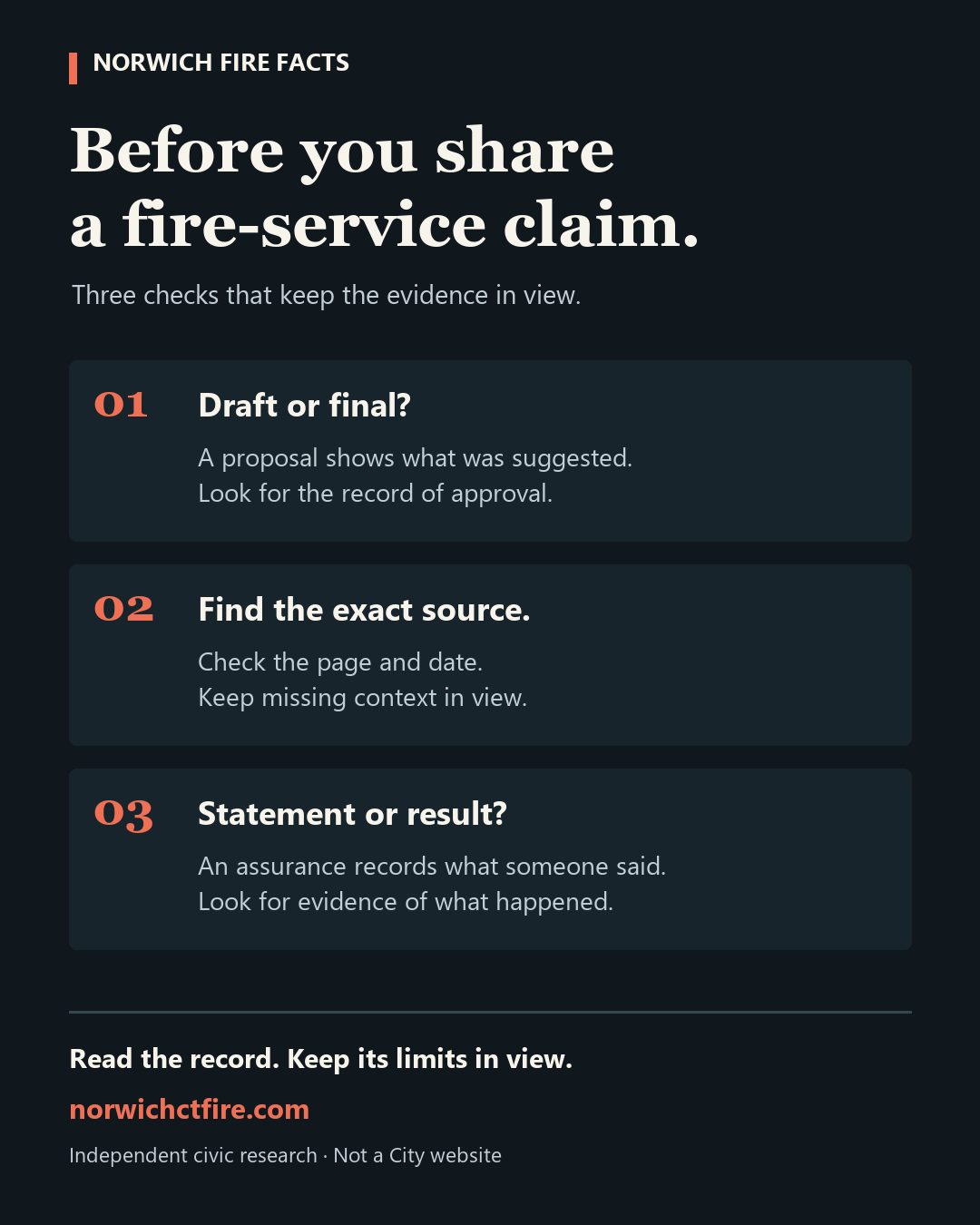
Three checks before drawing a conclusion
1. Is the record a draft or final?
A draft shows what someone proposed. Approval records help establish what was adopted.
2. Can you locate the evidence?
Check the source, exact page and date. If a date or approval is unverified, keep that limit in view.
3. Does it describe a reason or a result?
A stated reason or assurance explains what someone said. Operational records help test what happened afterward.
These checks guide this project's review. A finding should distinguish documented facts, attributed statements and unanswered questions, and change when the evidence warrants it.
Joseph DeLucia was publicly advancing a City-wide fire-services oversight structure in 2021.
June 9, 2021 Public Safety Committee minutes say DeLucia described the proposed director as administrative, said six chiefs would fall under the position, and said the City Manager included it in the budget because council members including DeLucia requested it.
Source record
Norwich Public Safety Committee minutes, June 9, 2021
An IPS engagement letter set terms for public-affairs support of the City’s Unified Command effort.
The February 25, 2026 letter states a $4,500 monthly rate. The produced copy has an IPS signature but the City acknowledgment name and signature lines are blank, so the document alone does not establish the duration or total paid.
A written six-month analysis or report was delivered to the City Manager.
After a records request sought the report, the City Manager responded on April 14, 2026: “I have verbal reports not written reports.” His response describes verbal reports; this chain does not establish their contents or quality. No written six-month analysis appears in the supplied chain. The October 2 review located four February written assessments and a February 24 transmission. Whether those are the specific six-month analysis described publicly remains unresolved; read the updated guide.
Site analysis
NF-000045, email-chain PDF, p. 1; request context pp. 3–8. Selected transcriptions available.
The produced record substantiated approximately 100 documented volunteer-company failures.
The reviewed packet contains 18 report files covering 17 incident identities, not a 100-item failure analysis. The two 4323 files are different versions, not identical duplicates. Several involved false alarms, and six occurred inside the City Consolidation District. Chief Wilson also cautioned that the set was not a complete list of incidents he attended. The file may contain criticisms worth testing, but it does not substantiate the public shorthand of roughly 100 documented failures.
Source record
Incident-report production and City correspondence, reviewed March-April 2026
Redacted public copy in preparation
06
Disputed
The Otis Street fire, standing alone, proves a volunteer-company operational failure.
Otis Street is inside the City Consolidation District. Public reporting described a communications anomaly that delayed NFD notification by roughly four to five minutes, while the City continued an administrative review. The incident deserves exact reconstruction, but geography and dispatch evidence prevent it from being used responsibly as a one-line verdict against the volunteer system.
Source record
Public Safety Committee minutes and contemporaneous reporting
The records currently displayed establish a quantified, systemwide staffing or response shortage that required the later shutdown actions.
The current evidence inventory includes incident reports and public claims, but it does not yet include a produced written systemwide shortage analysis that connects measured deficiencies to each shutdown action. Additional records may change that result.
Site analysis
Current public-record production reviewed by Norwich CT Fire
Redacted public copy in preparation
08
Contradicted by records
Unified Command, by definition, requires every participating agency to surrender its own authority.
FEMA’s NIMS doctrine says Unified Command jointly establishes objectives and strategies while participating organizations maintain authority, responsibility, and accountability for their own personnel and resources. A local policy can add requirements, so Norwich’s exact text still matters.
The current dispute has one settled, citywide dollar impact for every taxpayer.
No single figure is responsible without a defined operating plan, district boundaries, staffing model, budget, grand-list assumptions, and a lawful funding mechanism.
Site analysis
Site analysis; budget inputs still being verified
Redacted public copy in preparation
Evidence file
The six-month analysis question
Source review updated September 29, 2026 · NF-000045, all 19 pages
What the record establishes
February 25 and March 10: The requester first requested incident details, then sought records behind the public reference to approximately 100 incidents, including internal reports and analyses (PDF pp. 13–14, 17–18).
March 11: Chief Wilson said the reporting-system records supplied were all records kept by NFD responsive to the request, while cautioning that they did not capture every incident he attended.
April 7–14: The requester renewed the report request. The City Manager replied, “I have verbal reports not written reports.” His executive assistant said she had no additional documentation in her possession (PDF pp. 1, 3–8).
The narrow conclusion: no written six-month analysis appears in this supplied chain. It does not establish the contents or quality of any oral analysis, prove the incident count was fabricated, or rule out responsive records elsewhere.
Read the request and replies together, including Wilson’s incomplete-attendance warning and the requester’s initial March 11 acknowledgment that he would file the request as completed.
A critical narrative is not the same thing as a documented system failure.
The produced set should be read as a collection of incident records selected in response to a request—not as a validated statistical study. Its evidentiary limits matter before anyone uses it to condemn five companies or redesign the fire service.
The count does not match the public shorthand
The reviewed packet contains 18 report files covering 17 incident identities. Two different versions concern incident 25-0004323; they are not identical duplicate reports. The file is not a documented list of approximately 100 failures.
Geography complicates the accusation
Six of the unique incidents occurred inside the City Consolidation District. Otis Street was also inside the CCD, where reporting identified a delay in notifying NFD.
The timelines need underlying data
Some report summaries show units dispatched and arriving at identical times even where narratives describe sequential arrivals. Other entries use second-level timing. CAD, AVL/GPS and unit-status records are needed to reconstruct what actually happened.
The writing itself deserves scrutiny
Some narratives devote conspicuous space to criticism while omitting ordinary operational detail needed for independent review. That does not prove fabrication. It does make authorship, creation dates, edit history and contemporaneous source data essential.
The defensible conclusion is not “every criticism is false.” It is that the produced file does not independently establish the sweeping public story of roughly 100 documented volunteer failures. Each serious allegation should be matched to contemporaneous dispatch data, operational records and a stated standard.
Why “no documented systemwide failure” is the accurate formulation: individual narratives contain criticisms. Four written February assessments exist. This review has not established their connection to the specific six-month system analysis described publicly or to every restriction and structural change. Those are not the same claim.
Submit a correction
A stronger source can change a status.
Send the page, disputed wording, and the document that supports the correction. Material corrections receive a dated public note; viewpoint alone does not determine the result.